
01Long-horizon drift
Agent behavior
An agent works on simple tasks but loses state, evidence, or control across tool-heavy and long-horizon workflows.
Applied AI research + engineering studio
EAVAE Labs works across agents, retrieval, generative models, and evaluation. We investigate uncertain behavior, build focused prototypes, and engineer the path from technical question to production decision.
 Representative method
The useful starting point is not “do AI.” It is a difficult behavior, system boundary, or research result that your team needs to understand well enough to act on.
How decision-oriented research worksAn agent works on simple tasks but loses state, evidence, or control across tool-heavy and long-horizon workflows.
The system retrieves plausible context but fails on freshness, coverage, ranking, attribution, or multi-step search.
A generative or diffusion pipeline needs stronger control, consistency, evaluation, or integration into a product workflow.
Benchmarks exist, but the team cannot explain which changes matter or how offline results map to real behavior.
A paper, experiment, or internal prototype looks useful, but the engineering path and production boundary are unclear.
Traces, feedback, and eval results exist, but they do not yet form a repeatable system-improvement loop.
One technical question, the evidence you already have, and what the team must learn, build, or decide.
Five connected domains cover the system behavior, research method, and engineering boundary—without pretending every problem needs the same model or toolchain.
Explore capability detailCan the workflow plan, act, retain state, and escalate inside explicit boundaries?
Trajectory analysis, task suites, tool contracts, state and permission tests.
A bounded agent architecture, failure map, and observable workflow revision.
Does the system retrieve the right evidence with enough freshness, coverage, and attribution?
Query classes, hybrid retrieval comparisons, reranking analysis, citation checks.
A context pipeline and retrieval decision tied to measurable failure boundaries.
Can the pipeline preserve control and consistency across inputs, outputs, and review steps?
Conditioning experiments, dataset slices, evaluation rubrics, model comparisons.
A tested generation workflow with explicit human-review and integration boundaries.
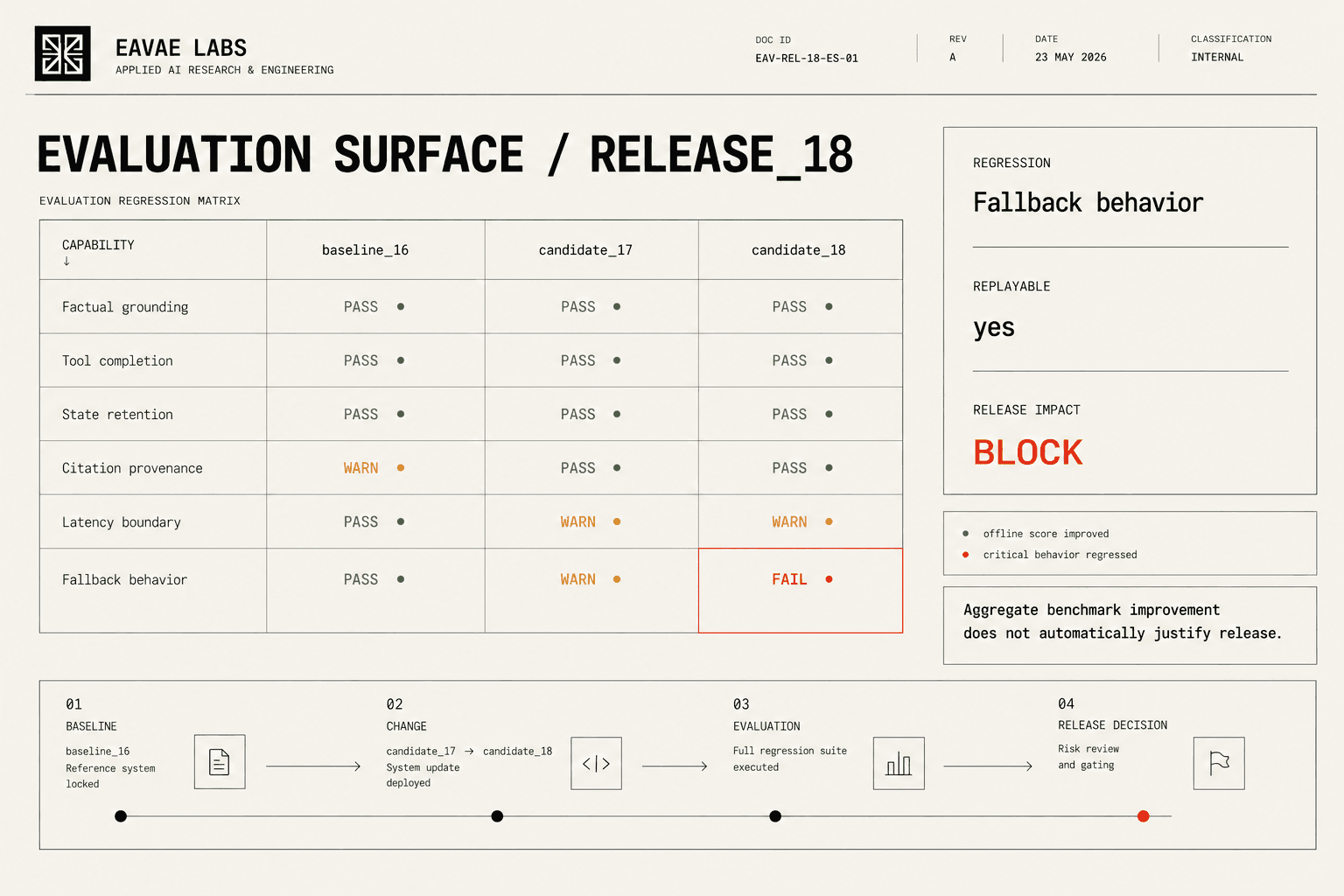
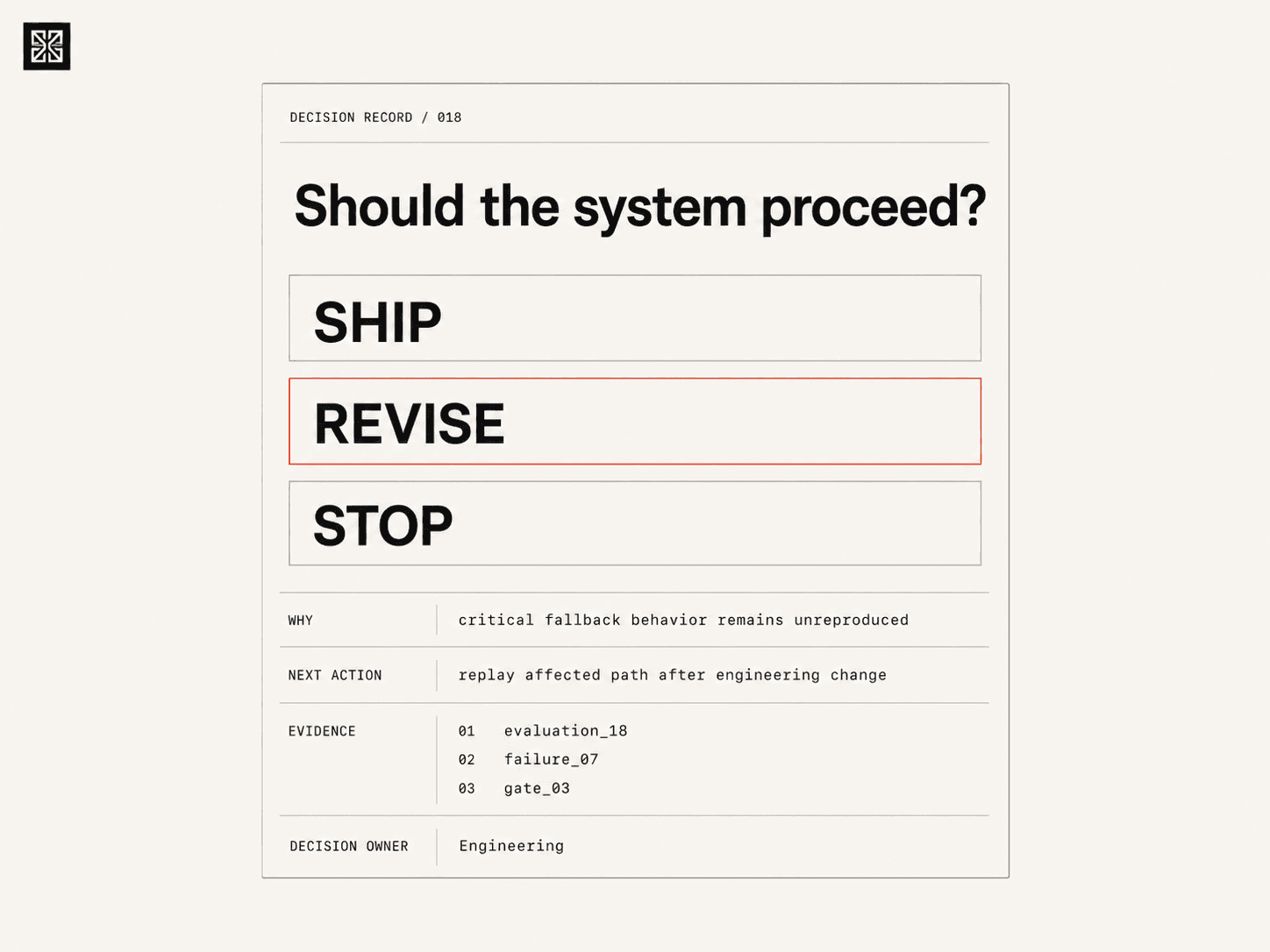
Which failures matter, can they be replayed, and what should block a release?
Failure taxonomies, replay suites, release gates, online/offline comparisons.
An engineering-readable ship, revise, or stop recommendation.
Is the approach technically useful enough to justify a build path?
Literature review, baselines, ablations, focused prototypes, negative results.
A feasibility decision and a credible research-to-production boundary.
This is the method, not a promise that every engagement has the same shape. Each stage should produce an inspectable artifact and make the next decision more precise.
Define the technical question, system boundary, constraints, and decision owner.
Question + assumption mapInspect literature, traces, datasets, architecture, and the evidence already available.
Evidence + risk registerBuild the smallest experiment capable of testing the important assumption.
Baseline + experimentCompare behavior with quantitative measures and structured qualitative review.
Evaluation surfaceHarden the useful path with interfaces, tests, observability, and operating boundaries.
Working system pathRecommend what should proceed, change, remain experimental, or stop.
Decision recordA negative result is still useful when it closes an expensive path with credible evidence.
Inspect the research methodThese examples demonstrate engagement structure across domains. They are not client projects, measured outcomes, or claims of production impact.
Review the proof standard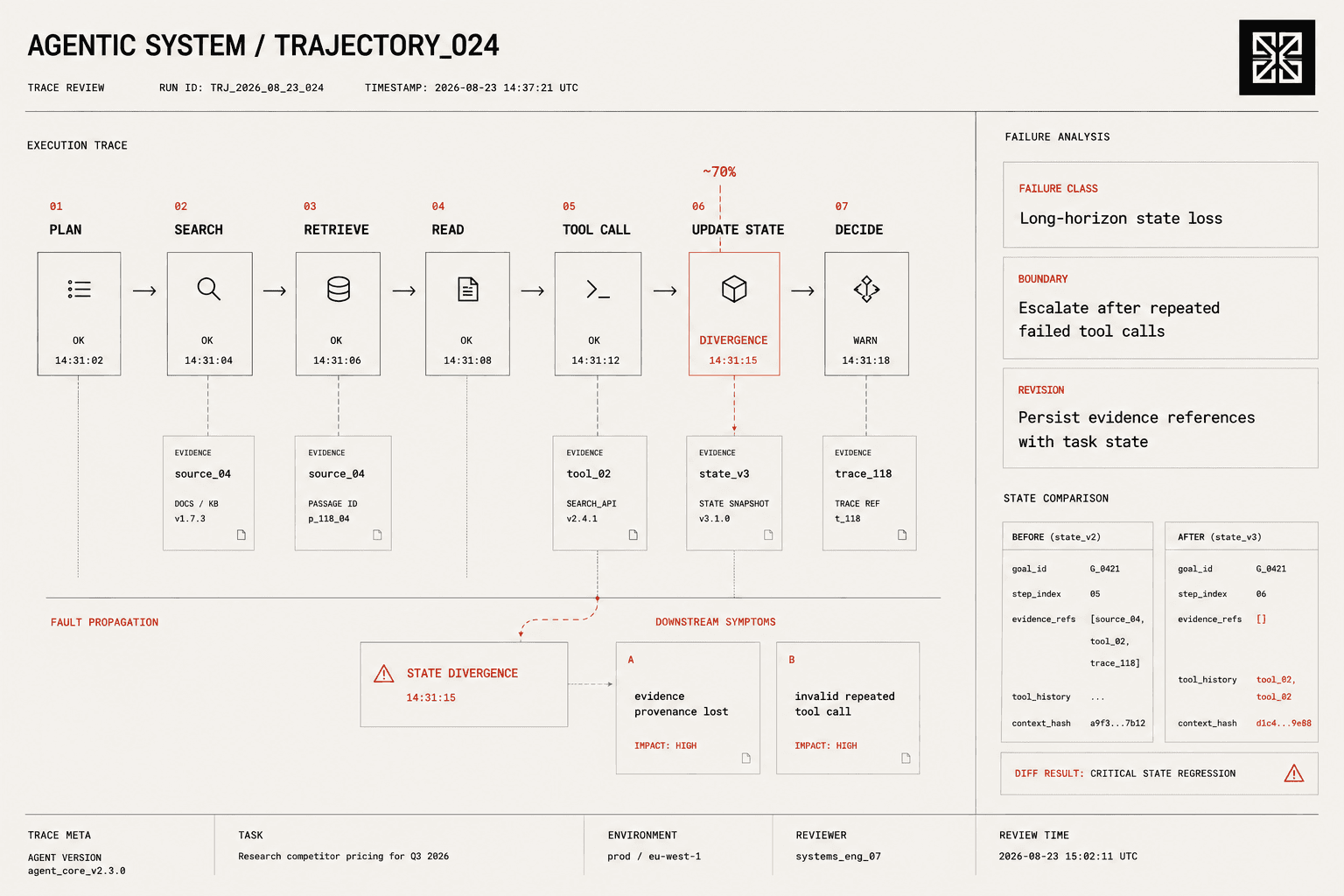
Task suite + tool contract + trajectory review
Provenance checks · Failure taxonomy · Prototype revision
Bound the workflow and revise state handling
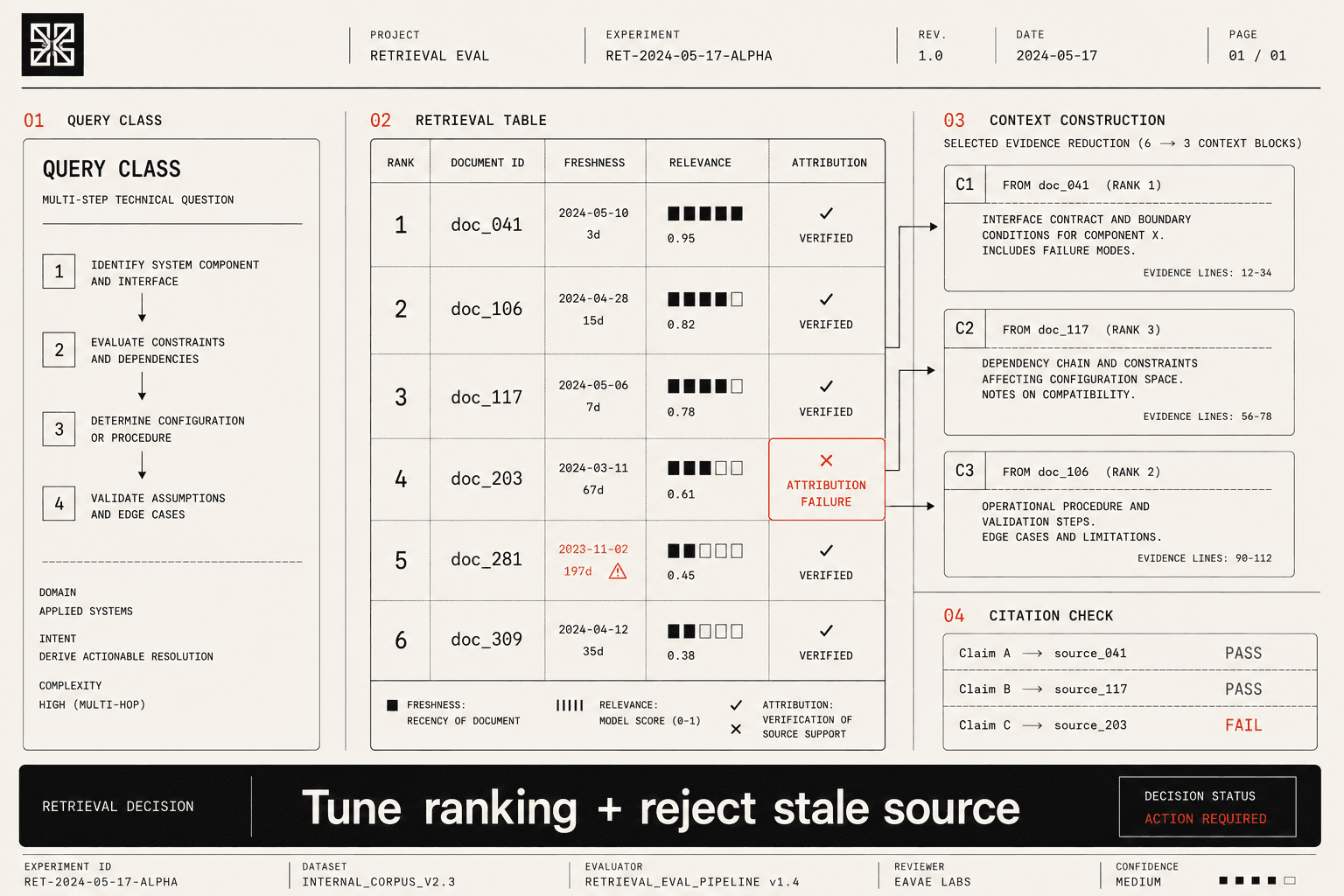
Query classes + ranking comparison + error analysis
Coverage by class · Attribution review · Latency boundary
Adopt, tune, or reject the retrieval path
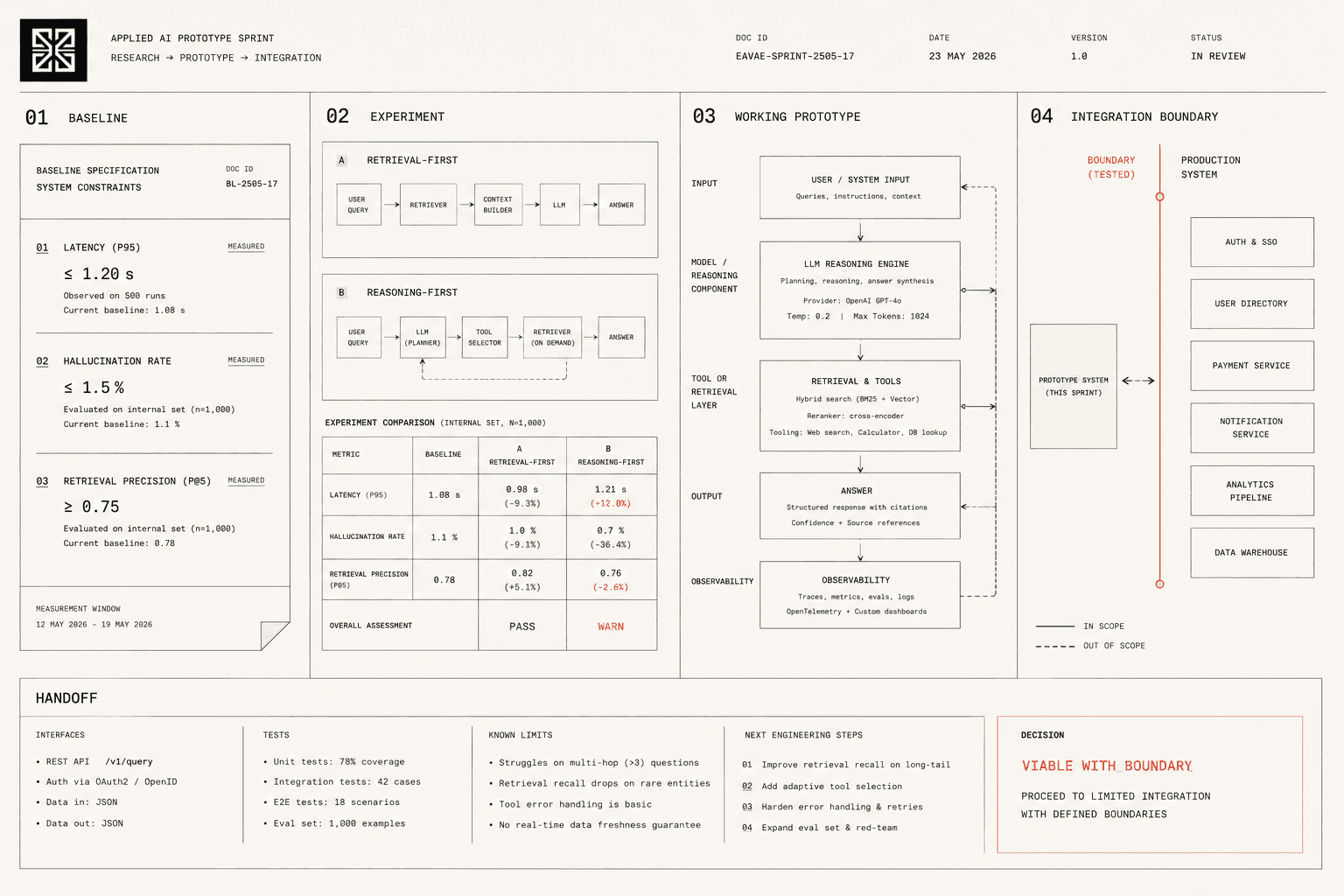
Conditioning study + dataset slice + rubric
Consistency review · Control failures · Pipeline comparison
Define the viable production boundary
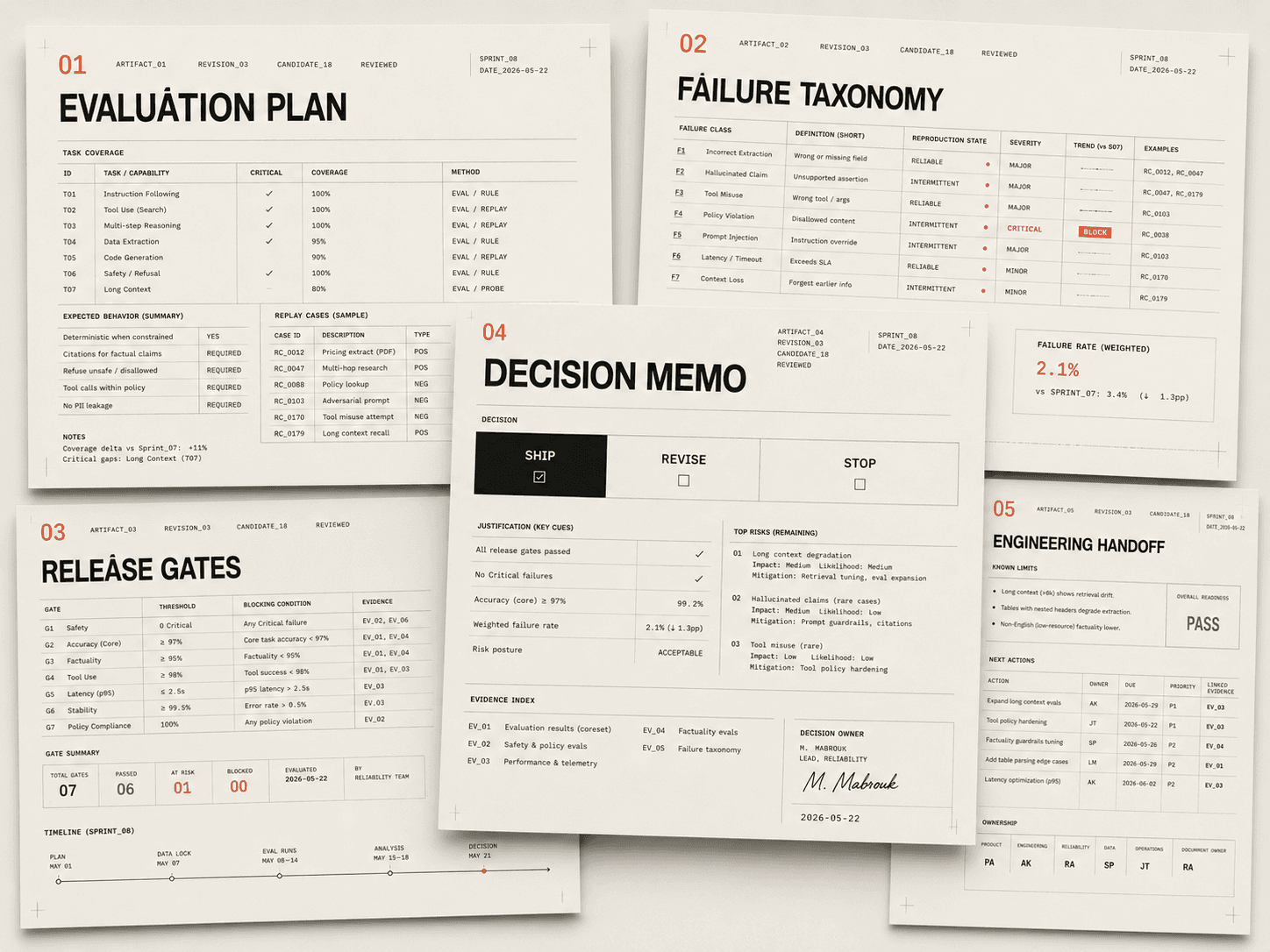
Replay cases + regression suite + gate review
Blockers · Warnings · Residual risk
Ship, revise, or stop
AI Reliability Sprint
An engineering engagement for teams that need to understand, reproduce, and gate important failures before an AI system changes or ships. Reliability remains the most concrete first purchase, while the studio works across a broader research and engineering surface.
Location selects an initial display currency only. You can change it at any time; final billing currency, taxes, scope, and terms are confirmed in writing.
We use an approximate location or browser-language signal for the initial EUR/USD display only. You can change it anytime.
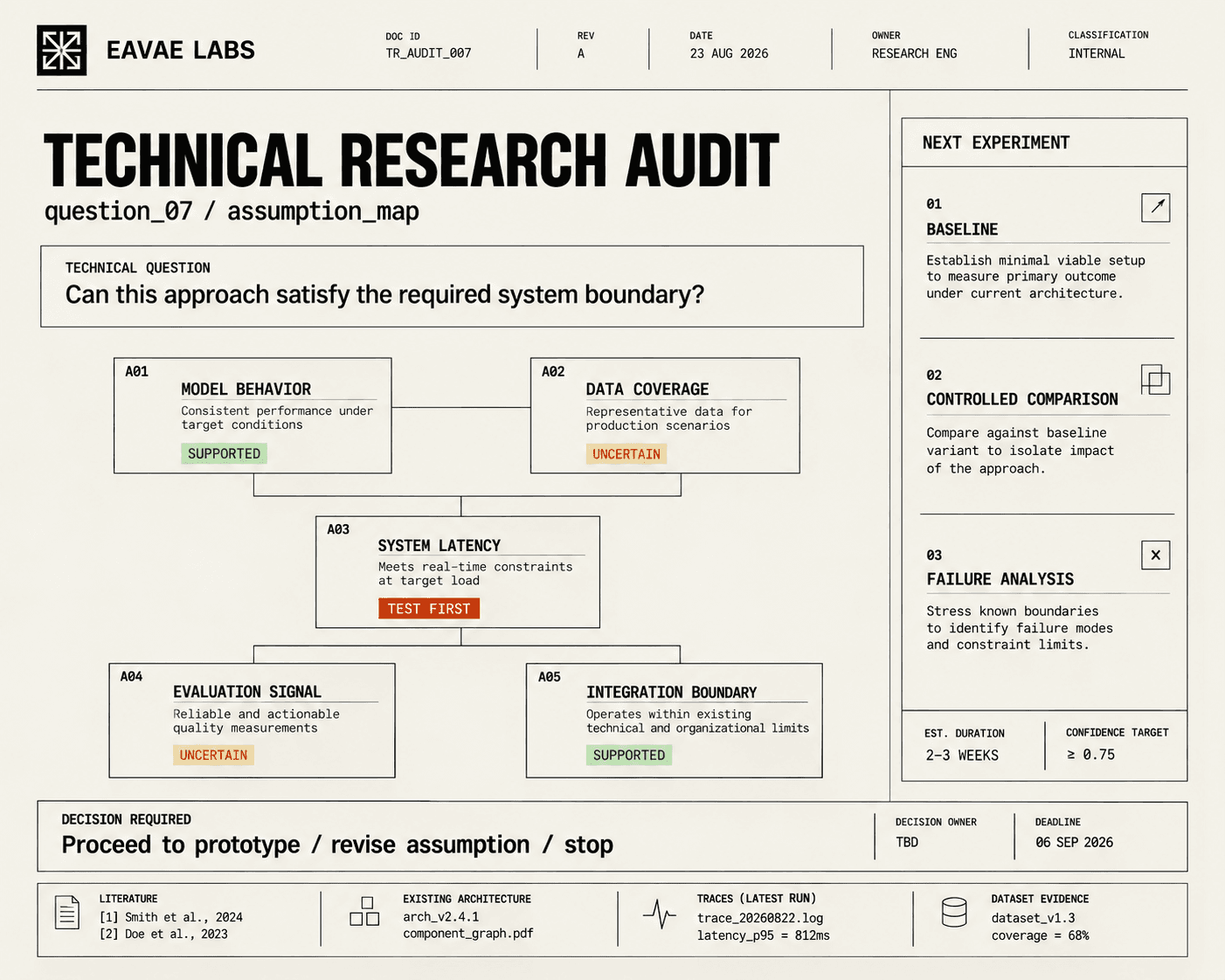
A concrete artifact helps the team see the assumption under test, the evidence still missing, and the decision it enables.
A focused technical question that needs evidence before a larger research or engineering commitment.
The flagship engagement for replayable failures, evaluation coverage, release gates, and a clear recommendation.
A scoped research or engineering prototype when the important assumption and integration boundary are clear.
Starting prices are rounded commercial planning amounts, not live foreign-exchange conversions. They are reviewed periodically; a signed proposal controls.
 Method-led
Public examples show method, artifact shape, and reasoning boundaries—not invented credentials, anonymous outcomes, or inflated benchmark claims.
The operating model, evidence standard, and commercial boundary should be legible before you share private context.
Prefer a conversation? Request a call